
From turtle nurseries to protected fishing zones, discover how marine conservation in Tunisia is taking shape on the ground. Read the full story here.
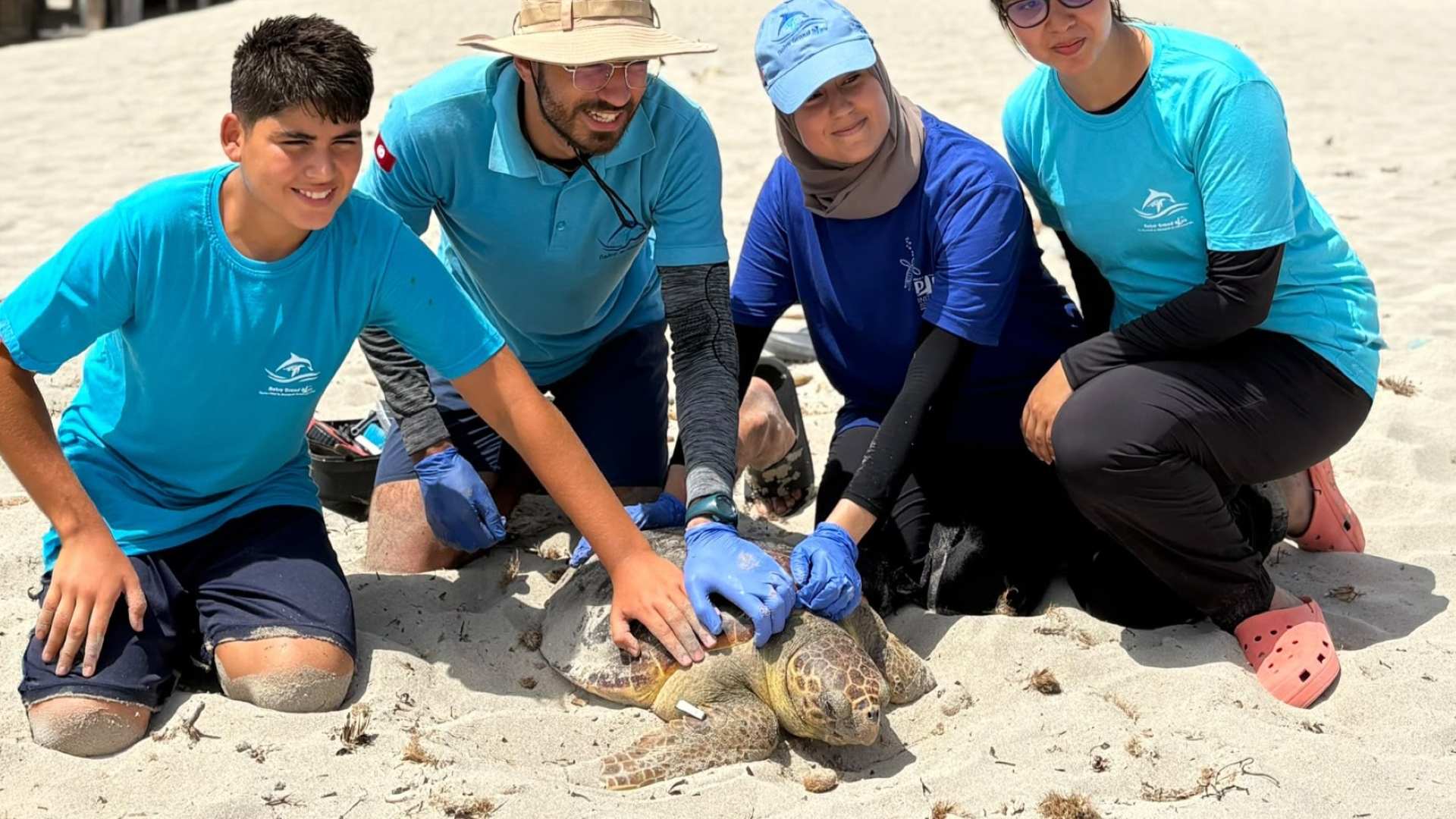
The Mediterranean is one of the world’s richest marine biodiversity hotspots, yet its protection remains patchy and unevenly distributed. In Tunisia, a handful of grassroots organisations are working directly with fishing communities, turtles and seagrass meadows to close that gap.
As part of the Together for the Med’s Support Programme for the Development of HPAs, our team was on the ground in Monastir and Sfax in July 2026 to meet two beneficiary organisations, Notre Grand Bleu (NGB) and the Association de la Continuité des Générations (ACG), and to follow up on their work and discuss their progress, priorities and ongoing activities.

This article explores the ecological stakes in these areas, the initiatives led by these two Tunisian NGOs, and how the programme is helping turn local commitment and action into lasting marine protection.
A biodiversity hotspot under pressure: marine protection in Tunisia
The Mediterranean Sea covers less than 1% of the world’s ocean surface but is recognised as a global hotspot of marine biodiversity, a status documented in detail by the WWF’s 2019 assessment of Mediterranean marine protection. Despite this ecological importance, protection across the basin remains far from adequate. A 2020 study published in One Earth found that although roughly 6% of the Mediterranean carries some form of MPA designation, the vast majority of that area applies regulations no stricter than open water, and only 0.23% of the Mediterranean is fully or highly protected, according to Claudet et al. (2020). Protection is also unevenly spread across the basin, leaving stretches of the southern and eastern Mediterranean, including Tunisia’s coastline, comparatively under-protected.
Tunisia offers an interesting perspective on this broader protection gap. While the formal designation of marine protected areas remains ongoing, the country has already developed strong co-management practices.

This is particularly relevant at sites such as the Kuriat Islands off Monastir and the Kneiss Islands in the Gulf of Gabès, where local organisations are actively involved in co-management and conservation efforts. Notre Grand Bleu, co-manager of the Kuriat Islands Marine and Coastal Protected Area, and the Association de la Continuité des Générations, co-manager of the Kneiss Islands Marine and Coastal Protected Area, are working alongside national authorities and local stakeholders to support the protection and sustainable management of these sites. The development of Highly Protected Areas (HPAs) can build on this existing work by helping to translate effective local management into a more ambitious level of marine protection.
An HPA designates a zone where extractive and damaging activities are minimised or excluded altogether, a distinction formalised in The MPA Guide, published in Science by Grorud-Colvert et al. (2021), which set out a shared framework for classifying levels of marine protection worldwide. Areas meeting this stricter standard are consistently linked to faster and stronger ecosystem recovery than areas with weaker enforcement.
Together for the Med built a partnership around two priorities: reducing fishing pressure while supporting the livelihoods of small-scale fishers, and developing a stronger network of effective MPAs across the Mediterranean, including through the promotion of HPAs.
It is under this second objective that the HPA support programme, backed by the Pew Bertarelli Ocean Legacy project, provides technical assistance and small grants to local organisations working to create or strengthen Highly Protected Areas.
Local Tunisian NGOs leading marine conservation: Notre Grand Bleu and the Association de la Continuité des Générations
Behind every protected hectare of sea is an organisation turning conservation goals into action: working with local communities, building trust, and finding practical solutions that can work on the ground. In Tunisia, two very different NGOs illustrate what this looks like in practice.
Notre Grand Bleu on the Kuriat Islands
Notre Grand Bleu began as an entirely volunteer-run initiative, founded by passionate sea lovers and experienced divers with a strong desire to protect their local marine environment. However, the association had no specialised expertise in marine science at the outset. Over time, the involvement of scientists and engaged students helped the association build conservation actions grounded in solid scientific knowledge.
Three species anchor Notre Grand Bleu’s monitoring work: the loggerhead sea turtle (Caretta caretta), Posidonia oceanica seagrass meadows, and the little tern (Sternula albifrons). The turtle programme in particular shows encouraging trends, with nest numbers and nesting observations rising year on year. The association has also observed changes in nesting behaviour, with turtles appearing to lay earlier in the season. While these observations require further study, they may indicate some degree of behavioural flexibility in response to climate change.


Notre Grand Bleu’s approach also rests on community involvement. Its outreach work started with children, through summer education programmes covering topics from turtle protection to waste management, and through partnerships with around forty teachers and school inspectors integrating marine themes into curricula, including using concrete examples in mathematics lessons, such as calculating the amount of plastic ingested by turtles. This engagement with children progressively extended to their families, particularly among children of small-scale fishers, whose fathers now play an active role in rescuing stranded turtles and taking part in projects addressing ghost fishing gear.
Tourism adds another layer of complexity and opportunity. The Kuriat Islands receive around 25,000 visitors a year, and Notre Grand Bleu’s on-site awareness cabin reaches between 5,000 and 6,000 of them, roughly a quarter of all visitors, through volunteers engaging with Arabic, French and English-speaking tourists. This work demonstrates that conservation can generate real economic value for local tourism operators, even as Tunisia’s current legal framework does not yet allow protected area managers to capture a share of that value through a fee-based mechanism.
This is precisely where the HPA support programme contributes. Together for the Med’s Support Programme for the Development of HPAs is funding the creation of a new turtle-nest nursery on Kuriat, needed because the existing one has reached capacity, alongside support for informational signage at the Monastir marina and an awareness campaign targeted at boat operators and their passengers during the crossing to the islands. The aim is to engage tourism operators as active stewards of Kuriat’s marine environment, while ensuring that visitors are introduced to conservation issues and responsible practices before they even reach the islands.
Association de la Continuité des Générations (ACG) on Sfax and Kneiss Islands
Further south, in the Gulf of Gabès, ACG works with fishing communities around the Kneiss Islands, a rural and comparatively remote area. Local engagement here means direct, sometimes difficult, dialogue. During consultation meetings with small-scale fishers on the placement of anti-trawling blocks intended to protect the seabed, fishers voiced frustration over practical needs, such as access to water and electricity, and questioned the effectiveness of the anti-trawling blocks. ACG addressed these concerns through open discussion and dialogue, and the discussions ultimately proved productive: five zones were jointly identified where fishers agreed to the installation of anti-trawling blocks.

ACG’s work extends well beyond zoning. When the local clam fishery collapsed five years ago due to the disappearance of shellfish stocks, the association helped develop an alternative livelihood for the fisherwomen affected: razor clam harvesting. By brokering a partnership with an Italian export company and a local processing business, ACG helped raise the price fishers receive from around 5 to 65 Tunisian dinars per kilogram, a substantial economic shift for the households involved.
Under Together for the Med’s Support Programme for the Development of HPAs, ACG is now working to translate the pre-zoning carried out by Tunisia’s coastal protection agency, APAL, and the zones agreed with fishers into a coherent map of priority areas for reef installation. The organisation is planning to deploy three artificial reefs, each weighing 1,200 kg, to protect the future HPA, and is drafting a dedicated charter for artisanal fishers in the area.
Results and lessons learned from the field: turtles, seagrass and fishing communities
What the numbers show
Notre Grand Bleu’s 2025 monitoring season offers a clear picture of the scale of its turtle conservation work. Field teams tracked 124 nests and recorded 6,299 eggs across the season. Around 54% of these nests needed to be relocated to a nursery to protect them from unsuitable conditions, and the effort paid off: 6,399 hatchlings emerged, roughly half of them from the nursery itself. At the time of a recent field visit, local fishers had already rescued 40 turtles from entanglement, a figure the association treats as a meaningful indicator of community buy-in rather than a purely ecological metric.
On the Gulf of Gabès side, ACG’s stakeholder process around Kneiss produced a concrete, negotiated outcome: five zones identified jointly with fishers for anti-trawling protection, built on direct engagement rather than top-down regulation.

Limits and lessons learned
Progress on the ground has not been without challenges. Some individuals involved in trawling or in the fish distribution chain joined the consultation meeting between ACG and small-scale fishers to defend their own interests, which added another layer of complexity to the consultation process. ACG itself acknowledges that engaging fishers sustainably usually requires financial incentives; asking them to give up a day’s fishing to help mark out a protected zone, for instance, means compensating them for lost income.
Regulatory gaps also constrain what conservation and livelihood programmes can achieve. Tunisian law currently offers no mechanism for protected area managers to capture revenue from the tourism activity their conservation work helps generate, limiting the long-term financial sustainability of sites like Kuriat. Similarly, the fisherwomen ACG supports through razor clam harvesting still cannot obtain the professional licence needed for foot fishing, leaving them in a precarious legal position despite years of advocacy.
Taken together, these results and limitations reflect what genuine field-based conservation looks like: measurable ecological gains, hard-won community agreements, and persistent structural obstacles that no single programme can resolve alone, but that sustained technical and financial support can help organisations navigate.


The experiences of Notre Grand Bleu and ACG show that protecting the Mediterranean’s biodiversity in Tunisia depends as much on relationships with fishers, tourism operators and local authorities as it does on ecological monitoring. Together for the Med’s Support Programme for the Development of HPAs is designed to strengthen exactly that combination, pairing technical assistance with targeted funding so that local organisations can turn field commitment into durable, better-managed protected areas.
Questions you might have
What is a Highly Protected Area (HPA), and how does Tunisia fit into the Mediterranean’s protection goals?
A Highly Protected Area is a zone where extractive and damaging activities are minimised or excluded, offering stronger safeguards than many conventional MPAs, following categories set out in the IUCN’s guidelines for marine protected areas. Tunisia’s coastline, including sites like the Kuriat Islands and the Gulf of Gabès, is considered a priority area for developing this stricter level of protection, given the ecological importance and vulnerability of these marine ecosystems.
Why are Tunisia’s Kuriat Islands significant for marine conservation?
The Kuriat Islands support important nesting grounds for loggerhead sea turtles, seagrass meadows, and colonies of little terns, while also attracting tens of thousands of tourists each year. This combination makes the site a valuable case study in balancing biodiversity protection with sustainable tourism.
Why are the Kneiss Islands important for marine conservation?
The Kneiss archipelago holds several conservation designations: a national nature reserve since 1993, a Specially Protected Area of Mediterranean Importance (SPAMI), an Important Bird Area (IBA), and a Ramsar site. It is also moving towards designation as a Marine and Coastal Protected Area (MCPA). The archipelago is a site of global ornithological importance, supporting up to 330,000 wintering shorebirds, or 70% of Tunisia’s wintering birds. It provides essential nursery and spawning grounds for marine fauna and supports the local economy through its mollusc resources.
How is the Together for the Med HPA programme supporting conservation NGOs in Tunisia?
The programme combines technical assistance, such as management effectiveness assessments and strategic planning support, with small grants of up to €5,000 to help organisations like Notre Grand Bleu and ACG implement priority actions, from building new turtle nurseries to marking out protected zones and supporting stakeholder consultations around local conservation priorities.